A New Life as "New Australians"
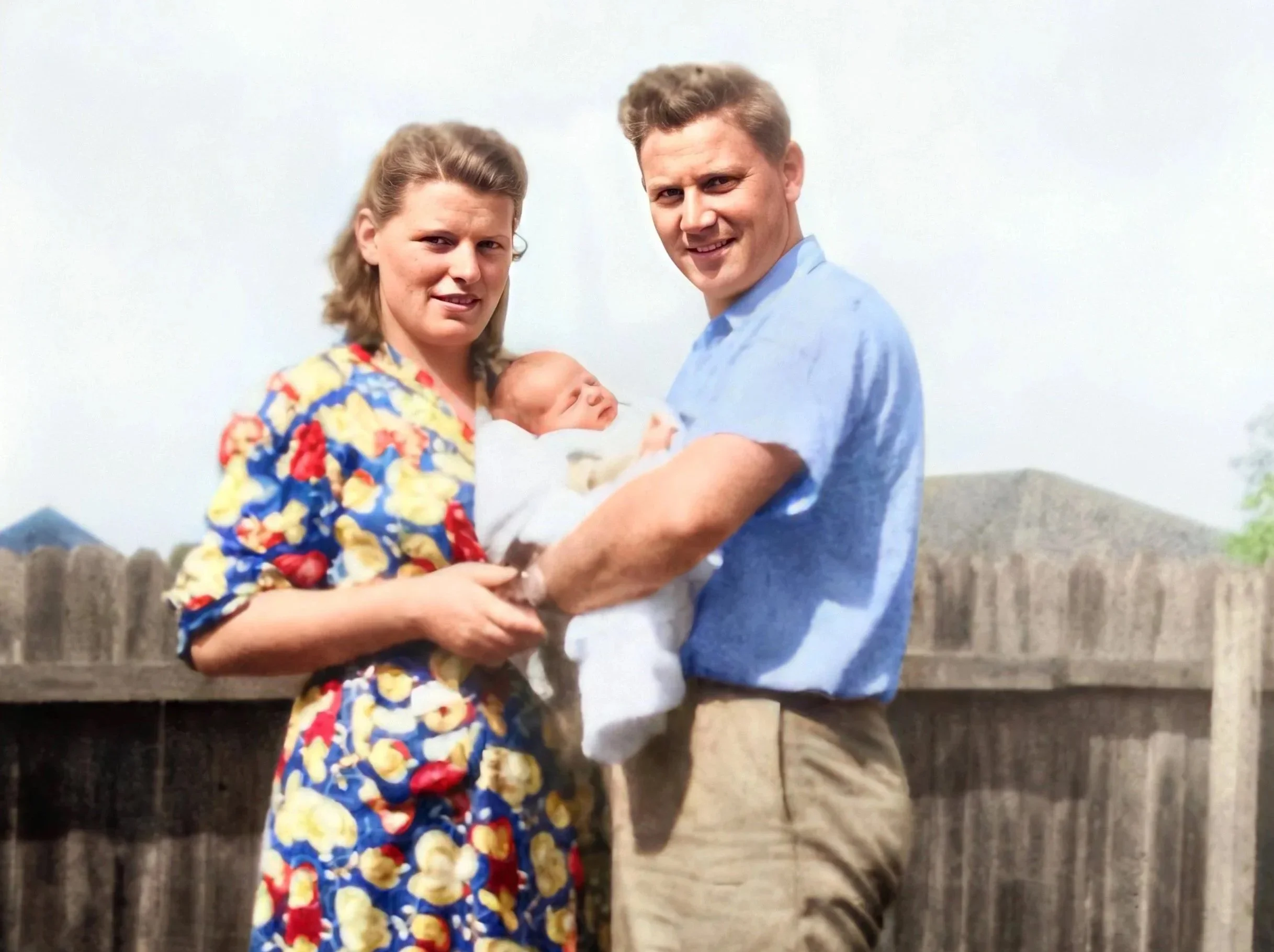
Ivan and Danila with newborn son, Daniel, in the yard of their first house at Guildford, Sydney, Australia taken soon after leaving Villawood Migrant Hostel in late 1951. The original photo has been colorised and enhanced
1949
Ivan Maurič and Danila Jakin escaped from Yugoslavia in October 1949, marrying in Gorizia, Italy two months later. Their subsequent journey to Australia in search of a better life echoed the story of thousands of other people displaced by World War and the political changes in Eastern Europe that followed.
Deciding to Leave Kozana
Post WW2 Ivan & Danila’s village of Kozana was left just a few kilometres from the new border with Italy. That border had only been agreed between Italy and Yugoslavia in the September 1947 Paris treaty. It wrapped around Goriška Brda on three sides (West, North, and South), effectively turning the region into a geographic peninsula protruding into Italy.
For the residents of Brda villages such as Kozana the new border was a disruptive shock. For generations the region’s economy depended entirely on the Italian city of Gorizia and the nearby Friulian market towns. Villagers went there to sell their local produce of cherries, peaches and wine; to purchase goods; and to access community services like hospitals. The new border severed these century-old connections overnight.
On top of that the new communist regime of Yugoslavia instituted wide-scale agrarian reforms and socialist nationalization laws. Farmers in Kozana were mandated to sell their produce and grapes to state cooperatives at fixed prices, fundamentally altering the centuries-old independent farm economy of the hills. The authorities made sure these changes were particularly hard on Slovenians deemed "politically unreliable."
According to Ivan’s later recounting his decision to leave Yugoslavia was driven by a determination to find a new life free from his homeland’s new communist regime. Danila's story was that she hated the thought of becoming a farmer’s wife. She did not like living in a small rural village where, according to her, “everyone always knew your business”.
Exactly when Ivan made the decision to leave Kozana we do not know. But this decision also offered Danila the escape she craved. Having been made, and legal departure not possible, Ivan and Danila had to find a new way to leave.
Escape into Italy via the “Green” Border
Brda’s rolling topography, featuring terraced vineyards and wooded ravines, made the physical border "green" (that is largely enforced by natural obstacles). But it was still heavily guarded by the KNOJ (Korpusi Narodne Odbrane Jugoslavije) border troops. Watchtowers, patrolled forest paths, tripwires, dog patrols and searchlights spanned the Brda ridgelines.
Movement in and through Brda was also subject to strict controls. Kozana and surrounding villages fell under a tough security regime. Unannounced visitors from other parts of Slovenia needed special authorisation to enter the region.
Crossing the international border without permission was treated as a serious crime, leading to shootings, arrests and detentions. But many Brda villagers were still prepared to take the risk. Young men and small family units relied on the locals’ intimate knowledge of local gullies, farm tracks and stream beds—often moving at night or during heavy fog. Escape plans were kept in complete secrecy, lest a casual comment alerted local informants.
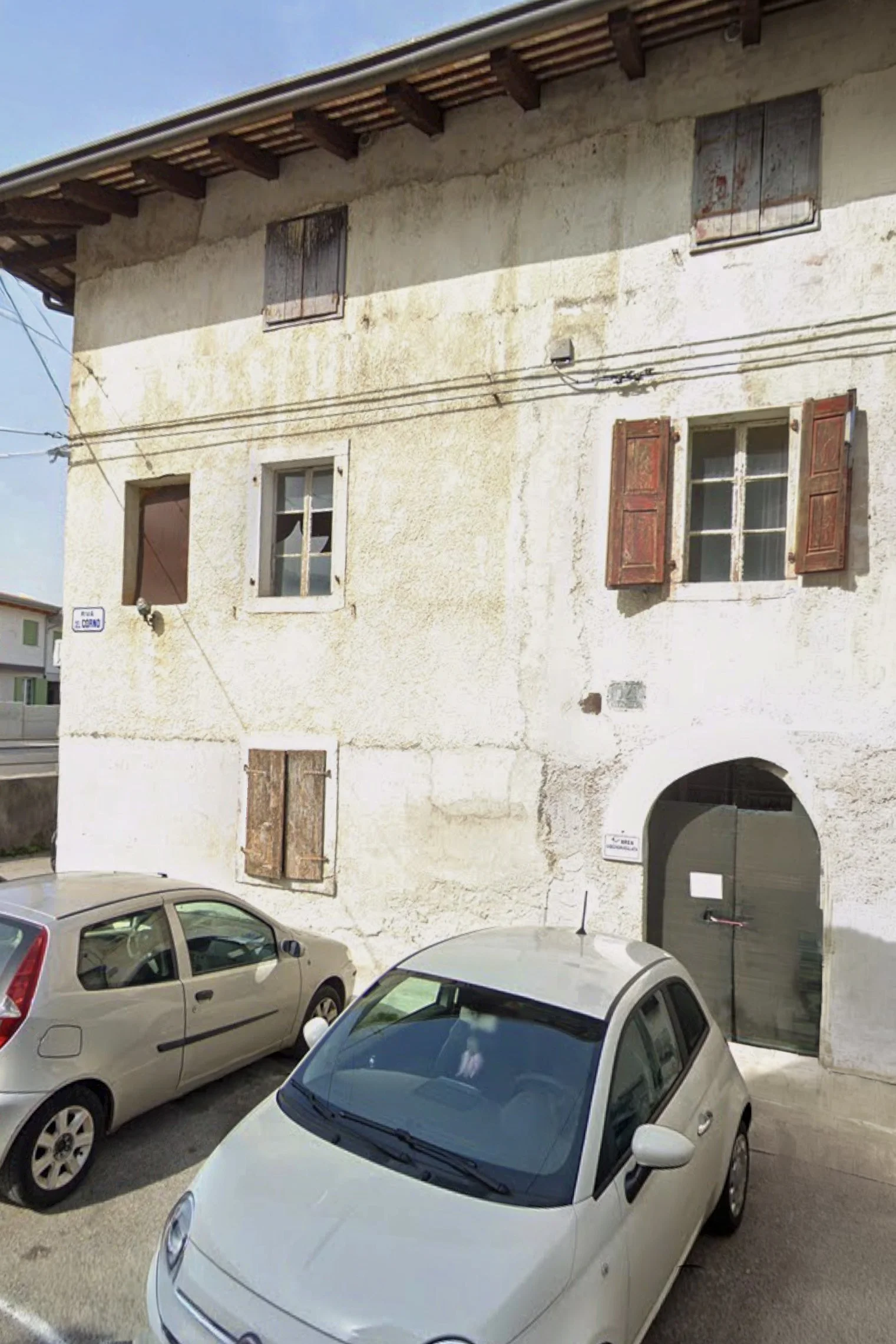
The house at 12 Riva del Corno, Gorizia where Ivan & Danila stayed with Danila’s aunt Louisa after escaping across the border from Kozana in October 1949
Many years later Danila’s brother, Milan, recounted that Danila had told her family that she was going to a larger Brda town to visit a dentist and would be staying overnight with a friend.
The first that her parents knew of her escape across the border was after she and Ivan contacted them from Gorizia. Danila and Ivan stayed there with Danila’s aunt Luisa at her house at 12 Riva del Corno. Louisa had found her own way to Gorizia sometime earlier with her husband, Raymundo Simčič.
Danila’s father, Rudolf, was apparently no fan of Ivan. According to Milan Rudolf regarded Ivan as a bit of a womanizer. But when Danila announced their intention to marry and leave Europe in search of a better life Rudolf took the decision in his stride. After all it meant that Ivan would be “doing the right thing” by Danila. And having himself travelled to Argentina in the 1920s to find work and better prospects no doubt Rudolf could also relate to their decision to leave.

Marriage of Ivan & Danila and of Ivan's sister, Alma, and Redento (Edi) Mian, Gorizia, 31 Dec 1949
Ivan and Danila married on New Year’s Eve, 1949 at the church of Santi Vito e Modesto in Gorizia. They had a double wedding with Ivan’s sister, Alma, and Redento "Edi" Mian. Ivan had also arranged for Alma’s escape from Yugoslavia. She arrived in late December, just a few days before the wedding. Redento had met Alma while working in Yugoslavia as very few jobs were available on the Italian side of the border at that time.
Leaving Europe
Almost immediately Ivan and Danila started looking for opportunities to leave Europe altogether. But crossing into Italy did not mean instant success. Italy viewed the influx of political refugees as a burden and forced them through a complex administrative process to assess the legitimacy of their claims.

Danila Jakin ID photo (repaired, colorised) from her IRO Resettlement Application, October 1949
As early as mid-October 1949, just days after their arrival in Gorizia, Danila had lodged an application with the International Refugee Organisation (IRO).
Ivan and Danila were treated as just another two of the hundreds of thousands of “Displaced Persons” (DPs) at the end of the Second World War who were unable or unwilling to return to their homelands dominated by communist regimes in Eastern Europe and Yugoslavia.
Danila’s application contains interesting insights into her life up to that point. For example, it notes she had only completed four years of elementary school and that since leaving school in 1942 she was a "peasant", working on house duties and helping out on her family's farm.
The application also provides her explanation of how, why and when she left her homeland. A key section of the application states “Though we have enough land to till at home, I [Danila] had to abandon it and join some works in the interior of the land; I was unwilling to go actually to forced labour; in 1948 I lost the membership card of the National Front*, because I was not frequenting the meetings and was completely inactive [in the organisation]. The state is trying to uproot the peasants from their land and degrade them to slaves of the state; people have to say: Yes! To all what the government requests. There is no [other] possibility. Who challenges it, finishes into jail."
*The “National Front” was the Liberation Front of the Slovene Nation which was one of the anti-fascist "national fronts" that had been established before WW2. Membership was effectively made mandatory for all citizens by President Tito's communist government after the war.
It seems very likely that Danila deliberately made her story as dramatic as possible to ensure she was accepted at a political refugee; indeed IRO policy was to reject claims made purely on the basis of economic hardship or of seeking a better life.
Even so this document does suggest that Ivan and Danila left Yugoslavia because things were getting risky, at least for Danila. She may have had a genuine and well-founded fear of being sent away from Kozana and her family because she was not showing the expected level of enthusiasm for the new regime.
Danila was accepted as eligible for IRO support and resettlement on 24 October 1949, less than two weeks after the application was lodged. And coincidentally exactly two years before first son Daniel was born.
Searching for a New Life
Danila’s IRO application makes clear that her preferred destination was Canada. But by March 1950 Ivan and Danila had been accepted for migration to Australia. As early as July 1947 Australia had entered into an agreement with the IRO for the resettlement of European DPs.
Many years later Ivan recounted that he and Danila had favoured Canada as their destination but settled on Australia when he found other Slovene DPs from Brda were already committed to going there.
It’s likely the real reason was a more practical one. The United States, Canada and various South American countries required that a prospective emigrant had personal sponsorship from a relative or friend already resident in the country, or guaranteed financial support and employment from a local welfare society.
Ivan and Danila may have switched to Australia as their new home because Australia’s requirements for emigrants were less strict than for other Western receiving countries. As well some DPs actively favoured Australia precisely because it was so remote from Europe and its troubles.
In mid-1950 Ivan and Danila were moved from Gorizia to a DP camp outside Bremerhaven in Germany in preparation for the journey to Australia.

Medical Report for Ivan as part of his application for acceptance for migration to Australia. The examination was conducted under the auspices of the International Refugee Organisation in Gorizia, 31 Mar 1950. The pictures of Ivan and Danila were transposed on their respective IRO files. Their files make fascinating reading
Australia it is!

Late 1940s poster promoting Australia to British families under the assisted migration program
The migration of Ivan and Danila has to be considered in the context of Australian policy at the time. After WW2 Australian migration was driven by a “populate or perish” philosophy. Initially Australia focused on providing assisted passage to British ex-servicemen and their families.
Later this was extended to other Europeans when Australia found it could not attract enough Britons. Assisted arrivals in Australia increased rapidly thereafter, reaching 120,000 in 1949 at a time when Australia’s total population was still less than eight million.

SS Fairsea, the ship that carried Ivan and Danila to Australia
Journey to Australia
Ivan and Danila departed from Bremerhaven aboard the ship Fairsea on 16 July 1950. The Fairsea had already had an eventful career. Originally built as a passenger and cargo vessel in 1941 she was converted into an escort aircraft carrier and then briefly served as a troop carrier after the war.
She was converted for migrant service in 1949. In this role the ship provided only very basic accommodation for 1,800 passengers. As one of the European DPs who travelled on a later Fairsea voyage recalled:
"There were no cabins, just huge big open spaces with triple decked bunks, so cramped you couldn’t sit up straight in them. Men were assigned to one section, women to the other. The toilet and shower facilities were one huge long one, and everywhere you went there was an awful reek of bleach. People threw up because of the smell, not just the swell!"
Bonegilla
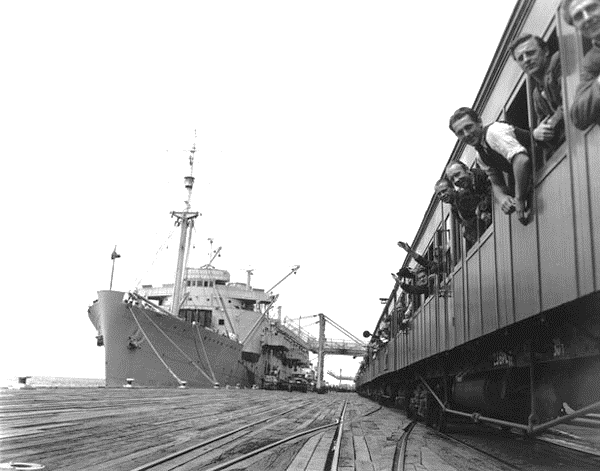
The Fairsea arrived in Melbourne on 18 August 1950. From there Ivan and Danila were taken direct from dockside in special trains to the Department of Immigration Reception and Training Centre at Bonegilla on the NSW-Victorian border. As another migrant on that very same trip remembered:
"We disembarked from the Fairsea and went straight to Bonegilla by train. The trip was a slow one. I looked into the backyards of Melbourne homes, and then watched the landscape change as the train travelled into rugged bushland, and the hours rolled by.
Finally, we arrived at the Bonegilla railway siding. It was late at night and very cold. People’s names were read aloud. I was issued with canvas sheets and blankets, and was sent to a room full of army beds. Like [for] the other migrants, my bed did not have a mattress, so I placed my sheets on the wire frame and wrapped myself tightly in the blankets to keep warm. The corrugated huts were unlined, and the gaps in the floorboards were big enough to let in the cold draught."
Bonegilla was one of a string of converted army camps used to house newly arrived migrants. During their stay at Bonegilla DPs were given a course of instruction in utilitarian English and the Australian way of life, to help them become good “New Australians”, as they were called.

Bonegilla Migrant Reception Camp located on the NSW-Victoria border near Albury, 1950

The camp may have been primitive, but to Ivan and Danila Australia seemed like paradise after the deprivations of Europe. Ivan wrote to his mother and sister, Alma, from Bonegilla in late September, just a few weeks after their arrival. That letter has survived. In it Ivan told his relatives back home:
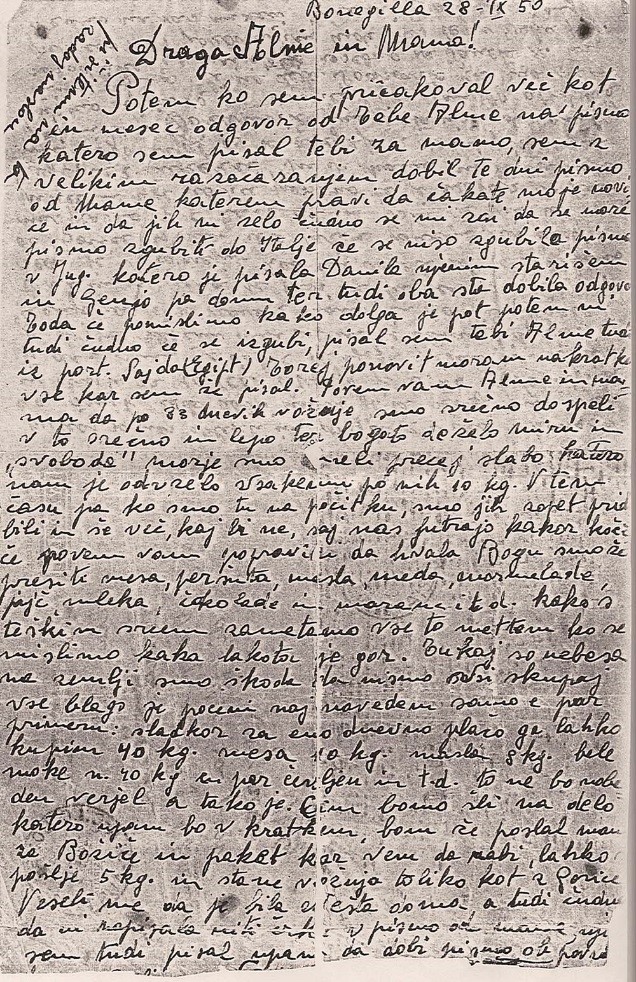
Ivan’s letter to his mother & sister, dated 28 September 1950
"After 33 days of travelling we safely arrived in this lucky and beautiful and rich country of peace and freedom….I honestly tell you that thank God we have already had so much meat, ham, butter, honey, jam, eggs, milk, chocolate….With a heavy heart we eat all this while thinking of the hunger up there [in Europe]. Here we have heaven on Earth, it's a pity we are not all here together. All goods are cheap. Let me give you a few examples: for one-day wages I can buy ?kg meat [text unclear], 10kg butter, 8kg white flour or ?kg [unclear text] wholemeal flour, one pair of shoes and so on. Nobody will believe this but that's how it is. When we start working, which I hope will happen shortly, I will send Mother [Kristina] a parcel [of food and essentials] as I know she needs it."
The assisted passage for Ivan and Danila to Australia did come with some conditions. All working age DPs undertook to remain in the employment found for them by the Government for a period of two years and their continued residence in Australia was subject to this undertaking.
At the end of this period DPs effectively became permanent residents with the normal rights of Australian citizens to live and work where they chose. New arrivals were interviewed individually to assess their employment potential, within the limited range of the government’s intent. Men had been recruited to work as labourers and unskilled workers, women as domestics, nurses and typists. Generally, any professional qualifications and technical skills the DPs already had from their homeland were ignored.
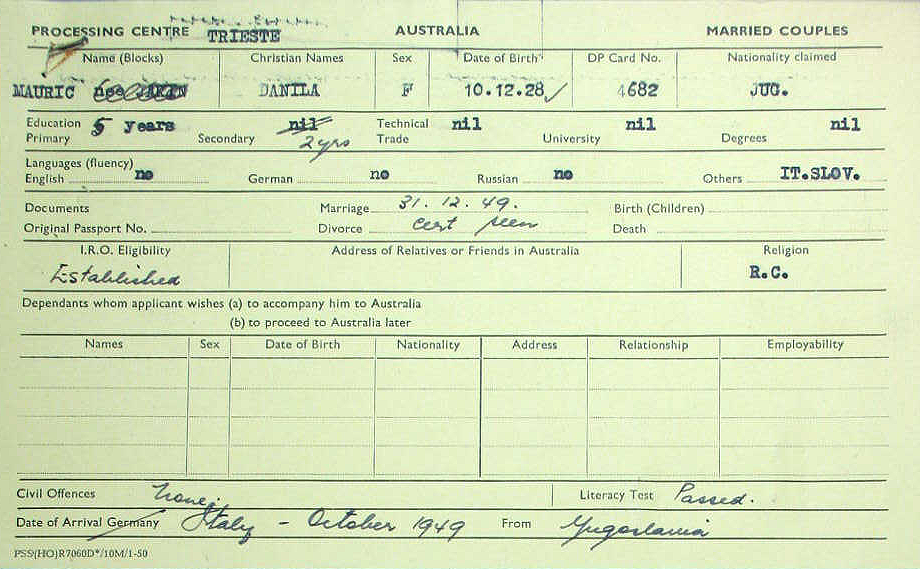
Danila's personal record card from Bonegilla camp, 1950. Note how her education level is listed as 5 years primary school and two years of secondary. This compares with four years primary only, which was listed on her IRO application in Gorizia just a year earlier. Which is accurate?
Danila later recounted that she was selected to work as a domestic servant on a farming property somewhere in country NSW. Her worst fear – a rural life – seemed again in prospect. According to Danila she was saved because when interviewed to assess her suitability for the position she “played dumb” and was passed over.
Ivan used to tell a different story, however. He claimed that it was his English language skills (although these were minimal) and his brief time in the Royal Air Force during the war that determined their future. Ivan said he claimed he was a qualified cook in the R.A.F. (although he was never more than a trainee) and that it was on this basis that he and Danila were assigned to the recently opened Villawood Migrant Hostel in Sydney rather than sent to the country.
However it happened it is true that Ivan ended up working at the Hostel as a cook and Danila in a nearby factory. They left Bonegilla on 12 October 1950 bound for Sydney.

Ivan the cook, Villawood Migrant Hostel, 1951


Danila's first job at a factory near Villawood, 1951
Villawood
Ivan’s cooking skills, however limited, would not have been tested too much in Villawood. Contemporary accounts record many complaints from the Hostel’s residents about conditions, some even taking to writing to the Immigration Minister seeking his intervention. Accommodation was even more basic than at Bonegilla (the Australian movie Silver City, released in 1984, gives a good sense of life in a hostel for post-War European migrants).
Food was plentiful but generally of poor quality and completely alien to New Australians. Mutton and lamb – not a regular part of many Southern European diets — featured prominently at almost every meal. To their tastes Australian staples—like bread, cheese and salad greens—were tasteless and boring. There was also a complete absence of European speciality foods—no espresso coffee, salami, pasta, olives or olive oil. Ham and devon were the best small goods on offer.
A particular complaint was that hostel residents were not allowed to prepare any food themselves. Instead they were compelled to rely on the canteen-style meals from the centralised kitchens which, ironically, was where Ivan worked.
Migrants no more
In October 1951 their first child, Daniel, was born. Six months later Ivan and Danila had managed to save enough to move out of the Hostel to a house at 158 Orchardleigh St, Old Guildford which they shared with other Slovenian migrants.
Ivan was determined to make it on his own terms and looked around for a business opportunity. Soon he found what he was looking for — his own fish shop at 825 New Canterbury Rd, Hurlstone Park.
The transition to becoming real New Australians was completed in November 1956 when Ivan and Danila were “naturalised” as Australian citizens. By then they had already adopted the name Maurice in the place of the anglicised form of their Slovene surname, Mauric. Ivan later explained he made the name change because he and Danila grew tired of it being continually mispronounced. In any case, Australia was now their adopted country and their new home.
So why not a new name as well?