WW1, its aftermath and the Reja and Mavrič families

Gorizia central square (Piazza della Vittoria), 1917 in the aftermath of fighting along the Isonzo front. Contrast this scene with the photo of the same square today, below
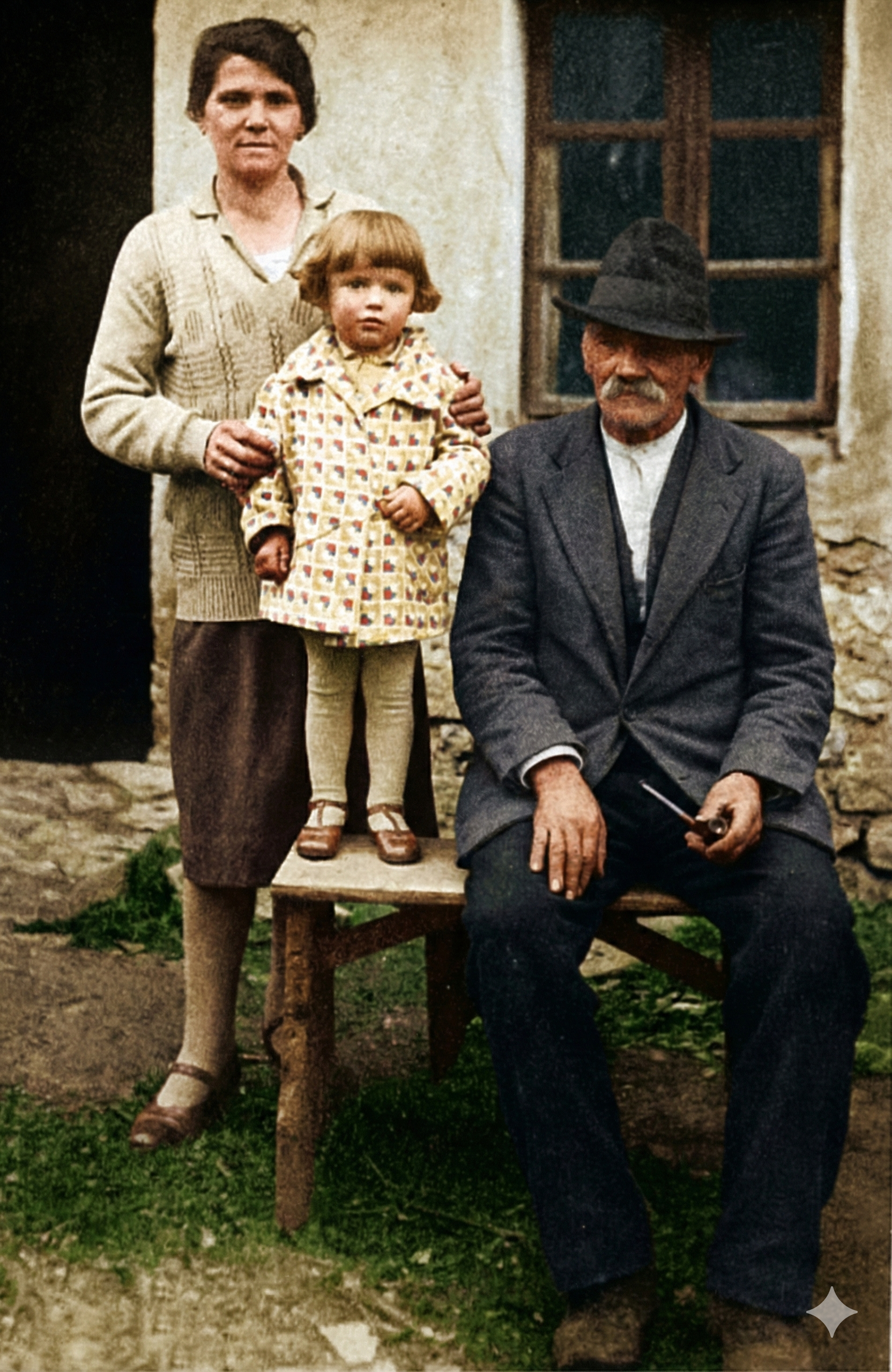
Danila, as a young girl with her mother, Livia, and maternal grandfather, Anton. Taken about 1932. Colorised photo.
1915
World War One involved bloody conflict around Gorizia, with a huge impact on the families of Brda. Both the Reja and Maurič family were expelled to southern Italy, returning after the War to a Kozana which was now part of Italy.
The Reja Family
Anton Reja (born 1859), the maternal grandfather of Danila, was an important person in her life. With her real father, Rudolf, working in Argentina until Danila Jakin was around 7 years old Anton was Danila’s “surrogate” dad until his death in 1934.
Anton had a total of ten children with three wives. At that time it was virtually impossible to survive alone with family in a small farming community like Kozana. Both widowers and widows tended to marry again very soon, often within just a few months of the death of their spouse.
Anton's second wife, Petrina Zuljan, was the mother of both Danila’s mother, Marija “Livia” (born 1903), and Livia’s sister, Alozija “Luisa” (born 1905).
Like her grandfather Anton Aunt Luisa was an important person in Danila’s life. Luisa married and moved to Gorizia and it was with her that Danila and Ivan first stayed when they escaped from Yugoslavia in October 1949. Danila remained close to Luisa throughout her life.
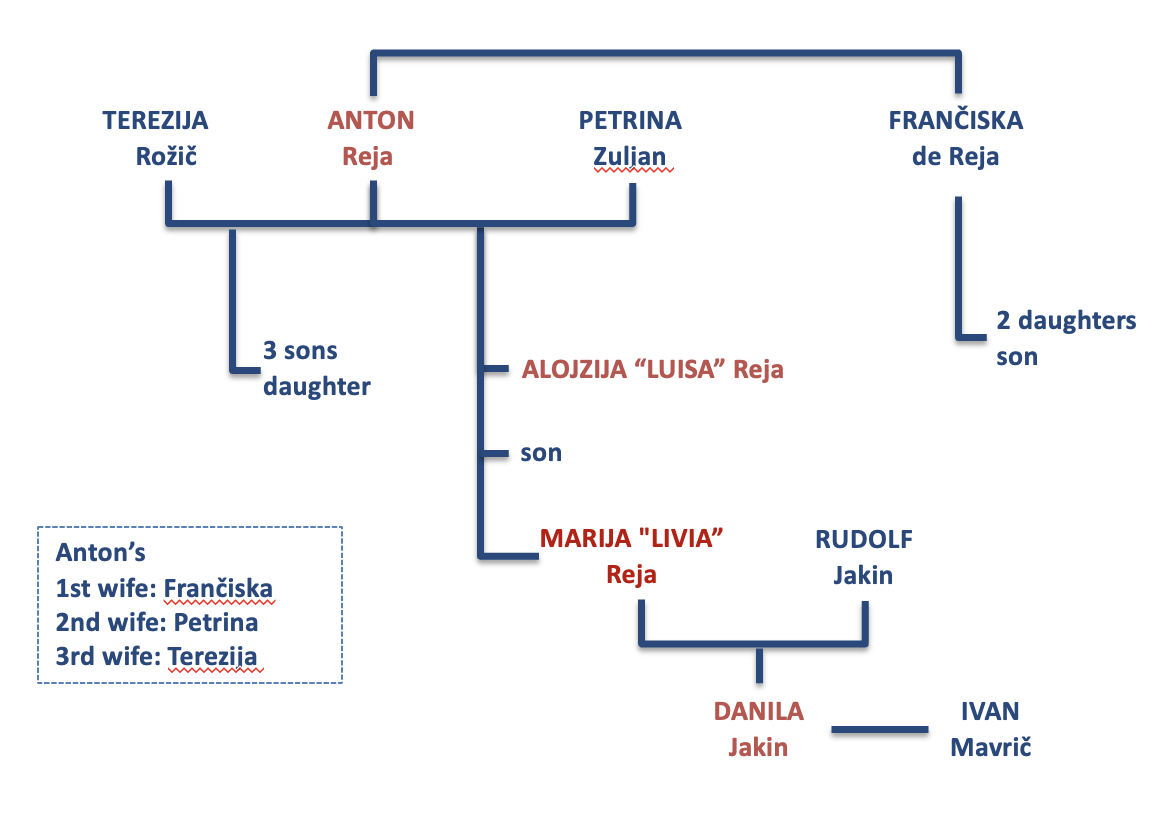
Going back in time Anton’s first wife, Frančiska de Reja, represented our family’s brush with European royalty. Frančiska’s grandfather, also called Anton, had been granted a noble title in 1735 by Hapsburg Emperor Charles VI, promoting him to the rank of a minor noble and landowner in the Goriška Brda region. It entitled Anton to attach the honorific “de” (“von” in German) to his surname and the use of an Imperial coat of arms.
de Reja family folklore was that the grant was the reward for an individual act of heroism in battle, but research suggests it was more likely to conferred for sustained tactical leadership, bravery under fire on the military frontier, or logistical service supplying imperial forces during the Habsburg wars of the early 18th century. Anton had two daughters and a son with Frančiska, who died around 1898.
The de Reja family is still active and has a long winemaking tradition in the heart of Goriška Brda. Operating out of Kozana to this day the present-day estate, specialising in “natural” wines marketed as Reja Wine (Reja Vino).
WW1 had a big impact on the Reja family. Brda was occupied almost immediately by the Italian army. (See Old Kozana, History and Family intertwined for more details about the Isonzo Front.) Most of the local villagers from Brda escaped elsewhere to Austro-Hungary at the outset of the war. But Anton Reja and his family stayed at their home, possibly because Terezija had both an infant (her 5th child, Franc, born 1914) and was pregnant with her 6th, Jozef (who died soon after his birth on 10 May 1915).
By June 1915 there was serious fighting around Brda. The Italian occupying forces expelled the remaining villagers to southern Italy. Anton Reja and Terezija with their children (including from Anton’s previous marriages) ended up in Palermo, Sicily. It was here that in 1917 their last child was born, Rozalija. As with many infants at the time she died only a few months later.
Meanwhile Bogomir Mavrič and his family were sent to a refugee camp in Caserta, north of Naples . While there their first son, Bogomir junior, died during the great Spanish Flu epidemic of 1917. He is buried somewhere in the Caserta region.
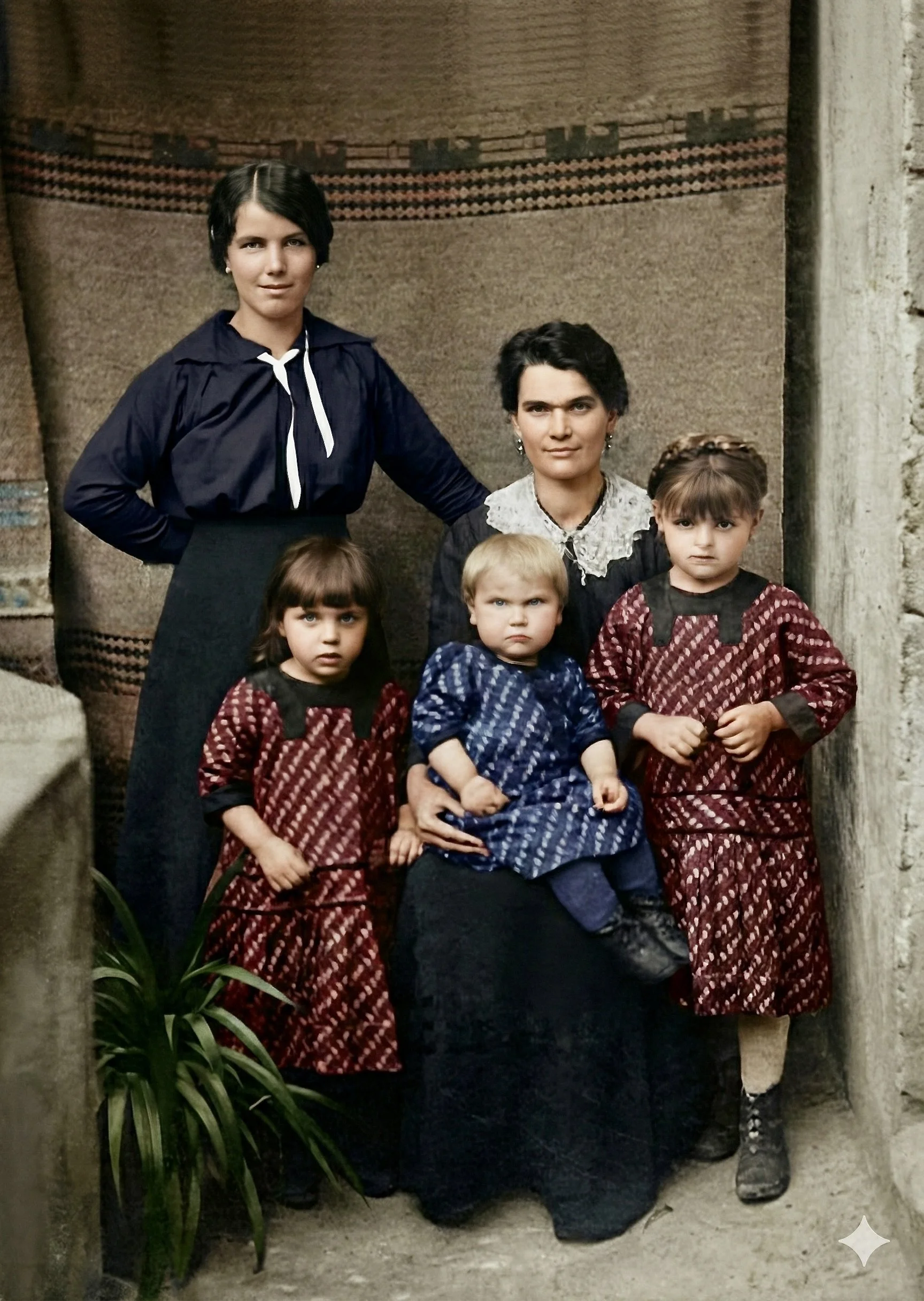
Mavrič family taken about 1917, probably in Caserta, near Naples. Standing is Kristina's younger sister, Giselle. In front (L to R) are daughter, Kristina ("Tine"), son Bogomir jnr (on Kristina's lap) and oldest daughter Ernesta. Bogomir died during the Spanish Flu epidemic Photo colourised.
The refugees from Brda in southern Italy lived a hard life, many in camps, and with little support apart from Slovenian priests expelled along with them. The first of these refugees began returning to their homes after October 1917. Most did not follow until the spring of 1919. Even then hardship continued. A significant part of modern Slovenia was ceded to Italy after the war including the Brda region, meaning that all the Kozana families were now regarded as Italian citizens. Italy was nominally a Kingdom under King Victor Emmanuel III, but with the rise of Benito Mussolini real power lay with his fascist government. Mussolini began a systematic campaign of what today we would describe as "ethnic cleansing" again all things Slovene.


Kristina's Italian passport, 1929
The family of Bogomir and Kristina continued to grow after their return. Another son Ivan, was born in 1921 and a third daughter, Alma in 1924. A further son, Rafael, was born in 1928. However like Bogomir jnr a decade earlier Rafael died as an infant.
Thousands of Slovenes responded to the problems they faced by migrating overseas, many to Argentina. At that time Argentina was a prosperous, booming economy. These emigrants included Danila’s future father, Rudolf Jakin, who first travelled to Buenos Aires in 1925 in search of a better life.
But that’s another story (see Argentina and the Jakins).
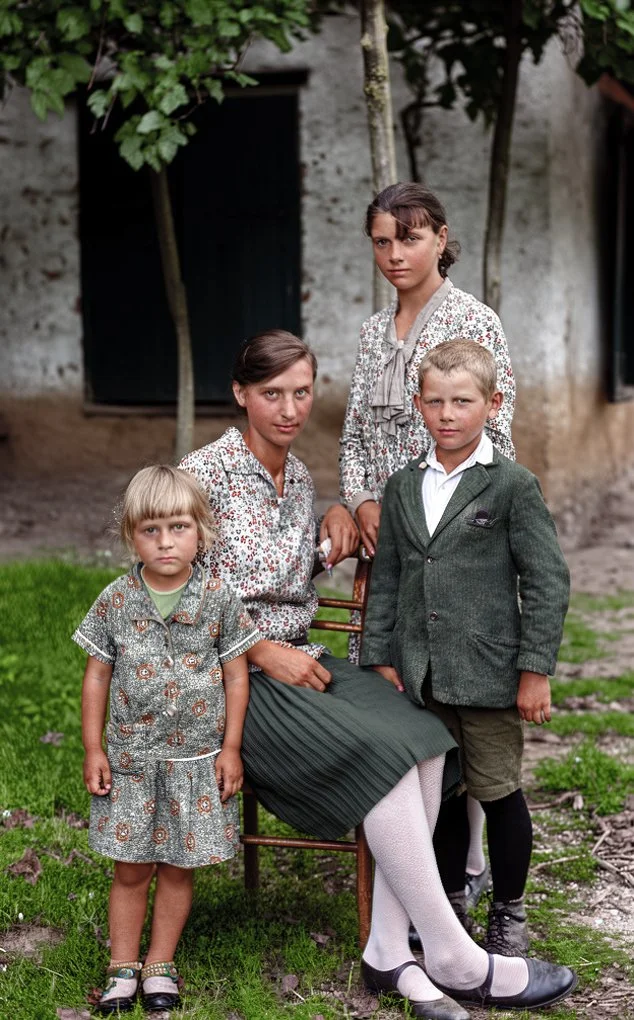
The Mavrič children, about 1929-1930: (L to R) Alma, Ernesta, Kristina and Ivan. Photo colourised.

Gorizia, Piazza della Vittoria, 2012.